
Nine out of ten startups fail, yet many UK business owners believe changing their logo will magically reverse declining sales. This misconception costs companies thousands in wasted effort whilst missing the real opportunity rebranding offers. True rebranding transforms your entire business identity, from mission and values to visual elements and customer experience. This article clarifies what rebranding actually involves, explains when UK businesses should consider it, and reveals how strategic rebranding drives measurable market share growth and internal cultural improvements for startups and SMEs.
Table of Contents
- What Is Rebranding And Why Does It Matter?
- Reasons Businesses Choose To Rebrand
- How Rebranding Benefits Your Business
- Key Steps In Planning Your Rebrand
- Discover Expert Rebranding Support For Your UK Business
- Frequently Asked Questions
Key takeaways
| Point | Details |
|---|---|
| Rebranding scope | Rebranding changes mission, values, visual identity, and target audience positioning, not just logos. |
| Primary drivers | Updating brand identity (57%), market repositioning (45%), and audience changes (41%) lead rebranding decisions. |
| Market impact | Successful rebranding delivers 15-25% market share increases within 2-3 years through differentiation. |
| Cultural benefits | Employee satisfaction rises 20-30% and internal communication improves 10-15% after strategic rebranding. |
| Planning essentials | Market research, stakeholder involvement, and clear objectives prevent costly rebranding mistakes. |
What is rebranding and why does it matter?
Rebranding is a strategic process where businesses change their corporate image to establish a new identity in the market. This comprehensive transformation extends far beyond surface-level visual updates. It reshapes your company’s mission, core values, messaging strategy, target audience focus, and every customer touchpoint.
Many UK business owners mistakenly reduce rebranding to logo redesigns or colour palette updates. One of the biggest misconceptions is that rebranding solely involves changing visual elements. This narrow view causes businesses to miss the strategic depth rebranding requires. A logo change without underlying strategic shifts rarely delivers meaningful business results.
True rebranding addresses fundamental questions about your business identity:
- Who are we serving and why should they care?
- What values drive our business decisions and culture?
- How do we differ from competitors in ways customers value?
- What promise do we make to customers and can we consistently deliver?
Understanding rebranding’s full scope matters critically for long-term survival. The competitive landscape shifts constantly, customer expectations evolve, and businesses must adapt or face irrelevance. Startups especially need strong brand foundations to differentiate themselves in crowded markets where 19% fail because competitors outperform them.
Rebranding isn’t about escaping your past. It’s about strategically positioning your business for future growth by aligning every element of your identity with where you’re heading, not where you’ve been.
For UK SMEs, rebranding offers a strategic reset when your current brand no longer reflects your capabilities, audience, or market position. It signals evolution to customers, energises employees around a renewed purpose, and creates competitive separation. Without this understanding, businesses risk treating symptoms rather than addressing root causes of stagnant growth or declining market relevance.
Reasons businesses choose to rebrand
UK businesses pursue rebranding for specific strategic reasons backed by recent market research. Understanding these drivers helps you identify whether rebranding makes sense for your company’s current situation.
Updating brand identity motivates 57% of rebranding projects, making it the most common driver. Markets evolve rapidly and brand identities that resonated five years ago often feel outdated today. Visual trends shift, customer expectations change, and businesses must stay relevant. A dated brand identity signals to potential customers that your business hasn’t kept pace with industry developments.
Repositioning the brand in the market drives 45% of rebranding initiatives. This strategic move helps businesses differentiate against competitors who occupy similar market positions. Perhaps you’ve expanded service offerings beyond your original niche or competitors have copied your positioning. Repositioning through rebranding creates fresh competitive separation and claims new market territory.
Reflecting a change in target audience accounts for 41% of rebranding decisions. Businesses naturally evolve their ideal customer profiles as they grow. Your startup might have initially targeted small local businesses but now serves national enterprises. Your brand identity must match the audience you’re pursuing, speaking their language and reflecting their expectations.
Addressing negative perceptions motivates 26% of rebranding projects. Sometimes businesses face reputation challenges from past mistakes, industry-wide scandals, or simply being associated with outdated practices. Strategic rebranding helps reset public perception when paired with genuine operational improvements.
Additional rebranding drivers include:
- Mergers and acquisitions requiring unified brand identities
- Geographic expansion into new markets with different cultural expectations
- Regulatory changes affecting how you can position or describe services
- Leadership changes bringing new strategic vision and direction
- Technology disruption forcing business model evolution
Recognising these drivers in your own business helps determine rebranding timing and scope. If multiple factors apply simultaneously, rebranding becomes increasingly urgent to maintain market competitiveness and internal alignment.
How rebranding benefits your business
Strategic rebranding delivers measurable business advantages beyond aesthetic improvements. Understanding these benefits helps justify investment and set realistic expectations for outcomes.
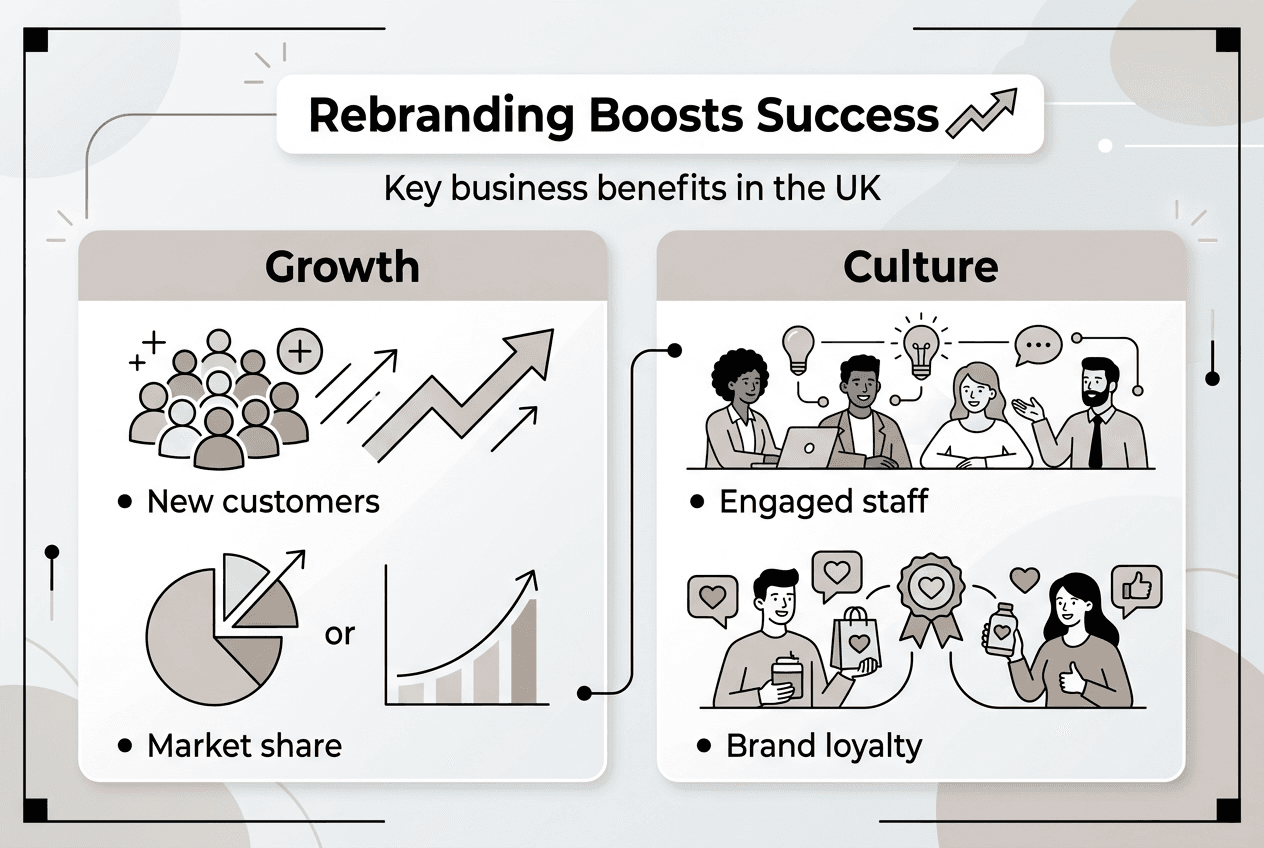
Companies that successfully rebrand see market share increases of 15-25% within 2-3 years. This growth stems from improved differentiation in crowded markets. When your brand clearly communicates unique value, potential customers understand why they should choose you over competitors. This clarity shortens sales cycles and improves conversion rates across all customer touchpoints.

Market share growth specifically benefits UK startups and SMEs facing established competitors with larger marketing budgets. Strategic rebranding levels the playing field by creating memorable positioning that resonates with specific audience segments. You’re not outspending competitors but outthinking them through sharper brand strategy.
Rebranding boosts employee satisfaction by 20-30% and improves internal communication by 10-15%. These cultural benefits often surprise business owners who view rebranding as externally focused. Your team craves clarity about company direction, values, and purpose. Rebranding provides this clarity, energising employees around a renewed mission they understand and believe in.
Improved employee engagement directly impacts customer experience quality. When your team genuinely believes in your brand promise, they deliver it more consistently. This authenticity builds customer trust and loyalty more effectively than any marketing campaign.
| Benefit category | Specific impact | Timeline |
|---|---|---|
| Market differentiation | 15-25% market share increase | 2-3 years |
| Employee satisfaction | 20-30% engagement improvement | 6-12 months |
| Internal communication | 10-15% clarity enhancement | 3-6 months |
| Customer perception | Measurable trust and loyalty gains | 12-18 months |
| Sales efficiency | Shortened sales cycles | 6-12 months |
Rebranding also creates natural marketing momentum. Launch announcements, updated materials, and fresh positioning give you legitimate reasons to re-engage dormant prospects and remind existing customers why they chose you initially. This momentum often generates immediate sales opportunities whilst longer-term benefits develop.
Pro Tip: Involve employees in rebranding planning from the start to maximise cultural benefits. When your team helps shape the new brand identity, they become authentic advocates who naturally communicate it to customers. This internal buy-in proves more valuable than perfect external messaging delivered by disengaged staff.
For UK businesses specifically, rebranding helps navigate post-Brexit market repositioning and demonstrates adaptability to changing economic conditions. Customers value businesses that evolve strategically rather than reactively scrambling when market pressures intensify.
Key steps in planning your rebrand
Successful rebranding requires methodical planning to avoid costly mistakes that undermine your investment. Follow these essential steps to maximise rebranding effectiveness.
- Conduct thorough market research and competitor analysis before making any decisions. A common pitfall is failing to complete this foundational work, leading to rebranding that misses market opportunities or copies competitor positioning. Research reveals gaps in the market, emerging customer needs, and positioning territories competitors haven’t claimed. This intelligence informs every subsequent rebranding decision.
- Involve key stakeholders including employees, loyal customers, and board members early in the process. These groups provide invaluable perspectives on what currently works, what frustrates them, and what they hope the business becomes. Employee input particularly matters because they’ll ultimately deliver the brand promise daily. Customer feedback ensures you don’t abandon elements they value whilst pursuing change.
- Define clear objectives and success metrics before starting creative work. Vague goals like “modernise our brand” fail to guide decision-making when choosing between design directions or messaging approaches. Specific objectives such as “increase enquiries from enterprise clients by 40%” or “improve brand recall among 25-35 year olds by 30%” focus efforts productively.
- Develop comprehensive brand messaging that articulates your positioning, value proposition, and key differentiators. This messaging foundation ensures consistency across all touchpoints from website copy to sales presentations. Without it, different team members communicate conflicting messages that confuse potential customers.
- Create detailed implementation plans covering every customer touchpoint from digital assets to physical materials, internal systems to external communications. Incomplete rollouts where some materials reflect the new brand whilst others show the old identity create confusion and undermine credibility.
- Plan your launch strategy to maximise awareness and momentum. Coordinate announcements across channels, prepare your team to answer questions confidently, and create content that explains the rebrand’s strategic reasoning to key audiences.
| Approach | Advantages | Disadvantages | Best for |
|---|---|---|---|
| DIY rebrand | Lower initial costs, complete control, faster decisions | Limited expertise, time-intensive, potential strategic blind spots | Very small businesses with tight budgets and simple positioning |
| Professional agency | Strategic expertise, comprehensive execution, proven processes | Higher investment, requires clear brief, longer timelines | Growing businesses, competitive markets, complex positioning |
| Hybrid approach | Balanced costs, expert guidance on strategy, internal creative execution | Coordination challenges, potential quality inconsistencies | Businesses with internal creative talent needing strategic direction |
Pro Tip: Never skip the customer feedback phase even when timelines feel tight. Existing customers provide reality checks on proposed changes and often highlight brand elements you’re tempted to abandon but they deeply value. This input prevents costly mistakes that alienate your established base whilst pursuing new audiences.
For UK SMEs, professional guidance often proves cost-effective by avoiding expensive missteps and accelerating time to market. The investment in expert strategy and execution typically pays for itself through improved market performance and reduced rework.
Discover expert rebranding support for your UK business
Navigating rebranding successfully requires balancing strategic thinking with creative execution whilst maintaining business operations. Many UK business owners find this juggling act overwhelming, particularly when they’re already stretched managing growth and competitive pressures. Professional rebranding services streamline this process by bringing proven frameworks, objective perspectives, and comprehensive execution capabilities.
Specialised agencies understand the unique challenges UK startups and SMEs face when repositioning for growth. They’ve guided businesses through similar transitions, avoiding common pitfalls whilst maximising strategic opportunities. This experience proves invaluable when you’re making decisions that will shape your market position for years. Whether you’re updating an outdated identity, repositioning against competitors, or preparing for expansion, expert guidance ensures your rebranding investment delivers measurable returns through improved differentiation, customer engagement, and market share growth.
Frequently asked questions
What is the difference between rebranding and brand refresh?
Rebranding involves fundamental changes to your business identity including mission, values, positioning, and target audience alongside visual updates. It represents a strategic shift in how your business presents itself and operates in the market. Brand refresh makes minor visual updates like modernising your logo, updating colour palettes, or refining typography whilst keeping core strategy unchanged. Both impact market perception but differ dramatically in scope, investment, and strategic intent. Choose rebranding when your current positioning no longer serves business goals or market realities. Opt for brand refresh when your strategy remains sound but execution feels dated.
How often should a business consider rebranding?
No fixed timeline dictates rebranding frequency because market conditions, competitive landscapes, and business evolution vary dramatically across industries and companies. Consider rebranding when significant changes occur such as major shifts in target audience, competitive positioning becoming ineffective, or company capabilities expanding beyond current brand positioning. Regular brand audits every 18-24 months help identify when minor refreshes suffice versus when comprehensive rebranding becomes necessary. Many successful UK businesses rebrand every 5-7 years to maintain market relevance, though some operate with consistent identities for decades whilst others rebrand more frequently based on rapid market evolution.
Can rebranding help a struggling startup survive in a competitive market?
Rebranding can significantly improve a startup’s competitive position when poor differentiation contributes to struggles, as 19% of startups fail because competitors outperform them. Strategic rebranding creates clear market separation, communicates unique value effectively, and positions your startup distinctively in crowded markets. However, rebranding alone won’t save startups with fundamental product-market fit issues, inadequate funding, or operational problems. It must form part of broader strategic improvements addressing root causes of competitive disadvantage. When combined with product refinement, improved customer service, and focused marketing, rebranding helps struggling startups reset market perception and claim defensible positioning.
How long does a complete rebranding process typically take?
Comprehensive rebranding typically requires 3-6 months from initial research through full implementation, though timelines vary based on business complexity, stakeholder involvement requirements, and scope. Strategic planning and research consume 4-6 weeks, creative development takes 6-8 weeks, and implementation spans 8-12 weeks depending on touchpoint quantity. Larger organisations with multiple divisions, extensive physical materials, or complex approval processes need 9-12 months. Rushing rebranding to meet arbitrary deadlines often produces suboptimal results that require costly revisions. Plan adequate time for thorough research, stakeholder input, creative exploration, and coordinated implementation across all customer touchpoints.
What are the biggest risks of rebranding and how can businesses avoid them?
The biggest rebranding risk involves alienating existing customers by abandoning brand elements they value without understanding their attachment. Avoid this through comprehensive customer research before making changes and clear communication explaining strategic reasoning behind updates. Another major risk stems from incomplete implementation where some touchpoints reflect new branding whilst others show old identity, creating confusion that undermines credibility. Prevent this through detailed rollout planning covering every customer interaction point. Internal resistance from employees uncomfortable with change also derails rebranding success. Mitigate this risk by involving staff early, explaining strategic rationale clearly, and providing training on communicating new brand positioning confidently to customers.